
Checking for a Warrant in Boulder County
Boulder County posts no public name-search list of warrants. That is the first thing to know. The Sheriff contact directory notes that the Warrants function handles process from the Twentieth Judicial District, but it sends warrant questions to Boulder County Courts at 303-441-3750. Call the court first for district or county criminal cases. Parking, animal, photo-enforcement, and city traffic matters stay with the issuing city court. When you call, have the full legal name, date of birth, and any case or citation number handy, plus any court notice. Ask whether the warrant is active, which court issued it, and whether it is an FTA, failure-to-comply, affidavit, arrest, municipal, or no-bond order. Also ask what step the court authorizes, since that shapes what happens next.
- Identify the likely state, county, or city court.
- Call Boulder County Courts for a Twentieth Judicial District case.
- Use Docket Search to locate a scheduled hearing, not to prove status.
- Check the named municipal court separately.
- Use a formal record request for a document copy.
- Call ahead before an in-person photo-ID request.
Boulder County Has No Warrant Portal
No Boulder County warrant portal exists. A jail roster shows who is in custody, not every active warrant. Colorado's free Docket Search lists hearings, not a warrant index. Paid vendors sell court data, but the Judicial Branch warns vendor files are not the official court record and may be incomplete. The Sheriff contact page lays out the local warrant route without exposing private case details.
A blank web result settles nothing. Only the issuing court or warrant office can confirm current status, and if you do not know which county issued the order, prior paperwork or a lawyer may help. Boulder County has no shortcut here, and Colorado offers no single free statewide warrant tool.
Boulder County Warrant Types
A warrant's label tells you how the case started and what fix may be open. Colorado uses bench warrant, warrant for arrest, failure to appear, and failure to comply. "Capias pro fine" is not the routine Boulder County term. Search warrants are different. They authorize a search of a place or item and usually face tighter access limits.
| Warrant type | How it arises | Who issues it |
|---|---|---|
| Arrest warrant | Sworn complaint or affidavit supports probable cause | Judge or magistrate |
| Bench warrant | Missed appearance or failure to comply | Judge or magistrate in an existing case |
| Municipal warrant | City-code, city traffic, or local court failure | Municipal judge |
| Search warrant | Probable cause supports a search of a place, person, or property | Authorized judicial officer |
Bench and arrest warrants can both end in booking. Where each began matters, because Boulder County excludes affidavit warrants from its walk-in process.
Boulder County Docket Search Reality
The free Judicial Branch Docket Search needs a date plus at least one other filter. You can narrow by location, court type, division, date range, case year, class, sequence, party name, or attorney. A result row may show hearing date, party, case number, hearing type, location, appearance type, and courtroom, and the export and print buttons save those rows. An advisement, appearance on bond, review, or walk-in add-on hearing can reveal the next step in a Boulder County case. Still, a docket hit is not a warrant list. Sealed, suppressed, new, juvenile, and city cases may not appear, a common name can pull someone else's hearing, and a clean result does not prove no warrant exists.
Use the docket as a route: take the case number and court from a result, then call the clerk for a current warrant answer.
Inside a Boulder County Warrant Record
A Boulder County warrant record can include the signed order, the complaint or affidavit, the register of action, a bond entry, and the service return. The ROA is the court's event log. It may note an issue, arrest, service, cancellation, recall, or future hearing without showing the full document.
| Case or warrant number | A local identifier such as a format resembling 2026CR###. |
|---|---|
| Subject | Name and other permitted identifiers used to distinguish the case. |
| Charge or basis | Offense, missed setting, or failure-to-comply reason when public. |
| Issuing court | The division or municipal court that controls the order. |
| Bond | An amount, bond form, conditions, or no-bond notation. |
| Status | Active, served, recalled, quashed, canceled, or another event. |
| Return | Agency service, arrest date, or cancellation details. |
An old copied Boulder County entry cannot establish today's status, so ask the clerk whether a later judicial order changed it.
Boulder County Court Record Requests
Once the clerk identifies a case, the Judicial Branch record request form can seek a complaint, disposition, protection order, ticket, ROA, or other document. It asks for contact data, case number and type, filing year, county, party name, date of birth if known, and whether you want certification. Answers generally arrive within three business days, subject to access rules. Fees run $0.25 per page, $5 for a name search, $20 for a certified or exemplified copy, and $30 per research or redaction hour after the first hour. Remember, a record request is no instant status check. For sheriff reports, Boulder County runs a separate process through its official Records Section.
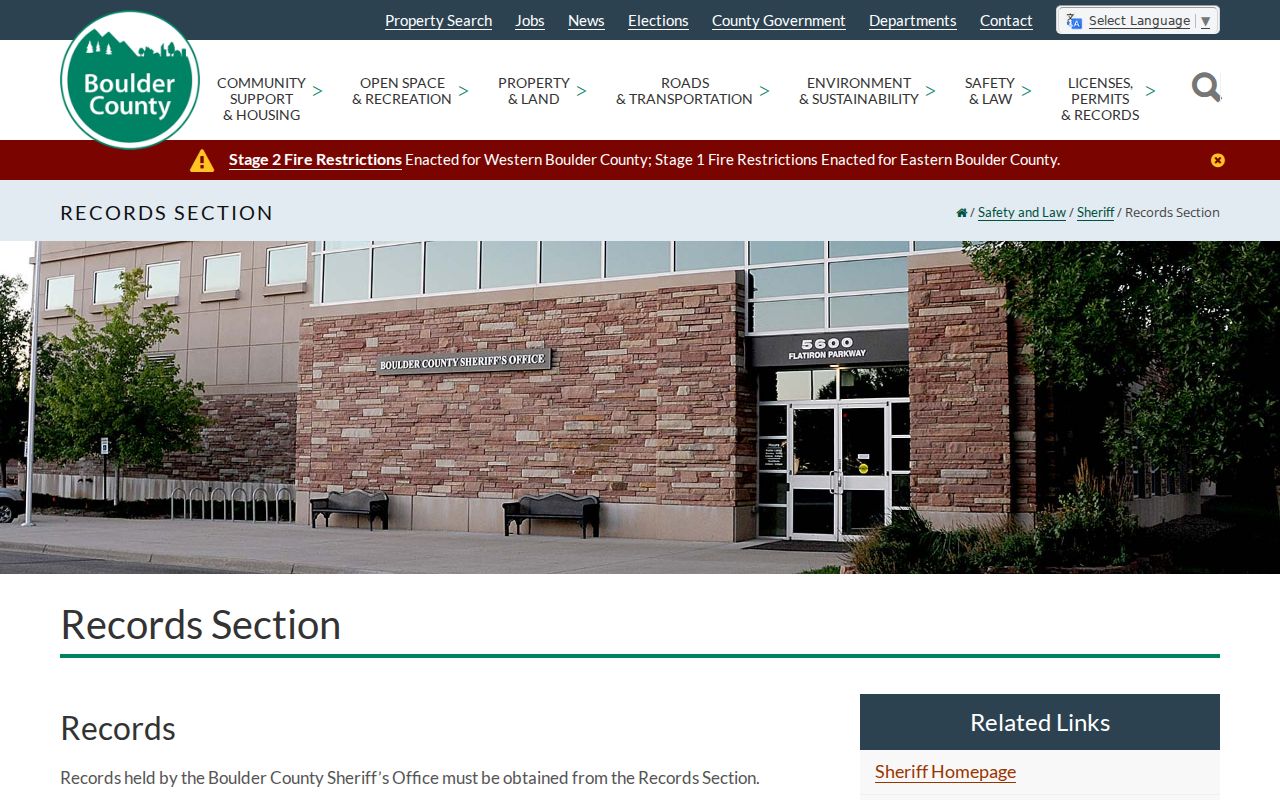
Sheriff reports use an agency form. Fees include a $5 report search with up to ten pages, $0.25 for added pages, and $40 per research hour. When Boulder County warrant status is urgent, call the court first.
Issuing and Serving Warrants in Boulder County
State warrants in Boulder County come from the Colorado District Court and County Court of the Twentieth Judicial District, while municipal judges issue city process. The Boulder County Sheriff holds and serves district, county, and civil warrants. Boulder Police, Longmont Public Safety, Lafayette Police, Louisville Police, Erie Police, Colorado State Patrol, and other authorized agencies may also serve warrants within their authority.
Twentieth Judicial District
The Clerk of Court maintains state district and county cases. Call 303-441-3750 for warrant confirmation.
Boulder County Sheriff
The Sheriff serves court process, operates the jail, and takes a photo-ID warrant request in person as the contact page directs.
Municipal courts
Each city clerk and judge controls its city-code and municipal traffic warrant records.
A serving officer cannot replace the issuing court's record in Boulder County. Ask the clerk for court documents and the creating agency for its reports.
Boulder County Walk-In Warrant Schedule
Eligible defendants can turn themselves in on a set schedule. The Twentieth Judicial District walk-in procedure spells out the days. Division 4 reports Wednesday at 8:00 a.m. Division 6 goes Thursday at 8:00, and Divisions 12 and 13 take Wednesday at 8:00. Boulder County Court and Longmont County Court both report Thursday at 8:00, with Longmont sitting at 1035 Kimbark Street, and add-on settings begin shortly after check-in. The clerk assigns the correct day, so call 303-441-3750 first to confirm the division, eligibility, and paperwork for a Boulder County warrant. Nobody eligible is arrested at the counter while being added. The limits are strict, though. Municipal warrants, other jurisdictions, Victim Rights Act cases, affidavit warrants, and specified no-bond alternative-jail warrants are all excluded. Show up on the wrong day and you may simply be sent home.
If You Have a Warrant in Boulder County
Call the issuing court, then a lawyer. That is the first move on any Boulder County warrant. Learn the type, status, bond, and authorized route, whether a walk-in add-on, a scheduled hearing, a motion, or a municipal quash appointment. Get every date and instruction in writing before visiting a courthouse, police department, or jail.
- Confirm the court, case number, and active status.
- Ask counsel about appearance, surrender, recall, or quash.
- Verify bond amount and accepted payment directly.
- Plan for possible custody when an affidavit or no-bond order exists.
- Attend the next hearing after bond or warrant resolution.
- Ask when the ROA will reflect the updated warrant status.
Do not assume protection: the walk-in procedure excludes affidavit and several no-bond warrants, and an appearance can lead to arrest.
A Boulder County warrant resolved is not a case closed. The underlying charge moves forward until the court enters a final result.
Fresh Start Boulder County Warrants
Fresh Start is Boulder County's own warrant forgiveness program. The May 2026 event covered eligible nonviolent, low-level misdemeanor and traffic warrants. Forty people attended. More than 38 warrants were resolved. Nobody was arrested there on a warrant. It was the Twentieth Judicial District's seventh such event, in a series that began in 2019. The 2025 event drew 53 participants. It resolved more than 45 warrants, again with no event warrant arrest. Those numbers describe program results only, not Boulder County's total warrant count. Officials frame Fresh Start as a way to set a new court date or resolve an eligible low-level case, not as an enforcement roundup. One past event creates no permanent eligibility. Check the official 2026 release and current court or district attorney news before counting on a future program.
Boulder County Warrant Records and Public Access
Colorado splits the rules. County records sit under one law. The Colorado Open Records Act governs ordinary county records, while criminal-justice agency records follow the Colorado Criminal Justice Records Act, C.R.S. section 24-72-301 and following. Court access answers to Chief Justice Directive 05-01 and the Supreme Court Rule on Public Access to Information and Records, known as P.A.I.R.R. The Boulder County CORA page routes ordinary requests through its Open Records Center. Sheriff matters go to Sheriff Records.
That Boulder County access page does not replace court-record rules. Sealed and suppressed files stay withheld. Juvenile access has special limits. Sensitive details may be redacted, and a warrant may be unavailable before service.
Public access is not complete access: a blank docket, denied copy, or redacted file does not prove that no warrant exists.
Boulder County Bond Payment Split
A bond comes from three places: the warrant itself, a judge, or authorized release procedures. The Boulder County Jail explains cash, co-signed personal recognizance, personal recognizance, property, surety, and no-bond cases. Its lobby at 3200 Airport Road takes specified payments. AllPaid supports remote credit or debit. The jail lists a $30 booking fee and $10 per individual bond. CJO 25-101, issued May 22, 2025, splits things further. Under that order, Twentieth Judicial District clerk offices accept certified-funds appearance-bond payments on qualifying monetary failure-to-appear or failure-to-comply warrants in traffic, misdemeanor, and lower-class felony cases. Affidavit-warrant bonds are different. They stay with Sheriff arrest processing so fingerprints are taken. Bond changes custody status. It does not resolve the charge. Confirm the amount, the form of funds, the appearance date, and whether the court has updated the warrant before relying on payment.
Boulder County Court and Sheriff Locations
The main state court is Boulder County Combined Court. It sits at 1777 6th Street, Boulder. Court hours run 8:00 a.m. to 5:00 p.m. weekdays, and clerk hours end at 4:00 p.m. Longmont Combined Court sits at 1035 Kimbark Street. The Sheriff headquarters is at 5600 Flatiron Parkway, and the jail is at 3200 Airport Road. The official Combined Court page provides the clerk route, location information, Docket Search, records email, and the walk-in warrant link.
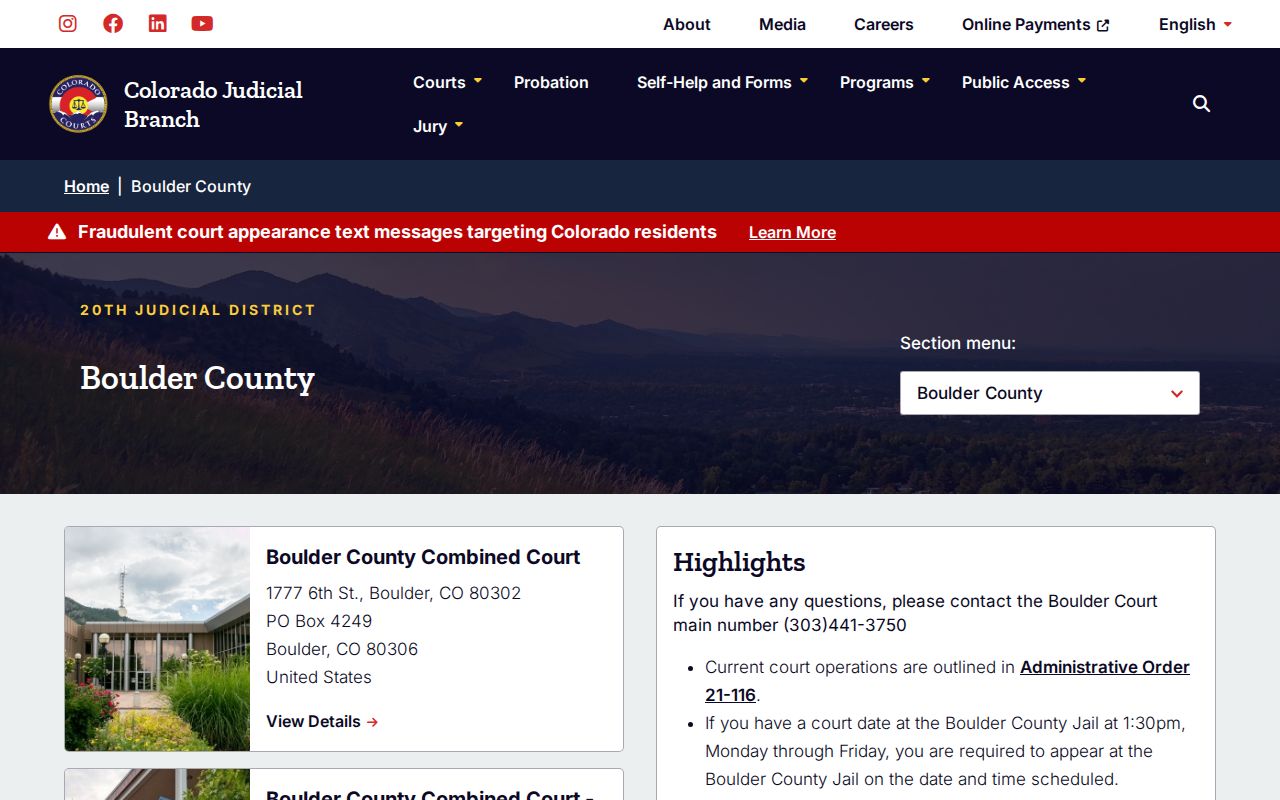
Always call before visiting a Boulder County courthouse in person. Court security applies, an active warrant can change what happens on arrival, the walk-in schedule is division-specific, and city municipal courts use different addresses and procedures.
Boulder County Warrants by City
Boulder County's five largest incorporated places each run a municipal system. A city page sticks to its police department, municipal court, and local warrant contact. It also covers the split between city and state cases. Match the city named on your summons, since a county court does not replace a municipal clerk.
Boulder
Boulder Municipal Court handles city ordinance, traffic, parking, photo-enforcement, animal, and misdemeanor cases. Check Boulder warrant routes.
Longmont
Longmont Municipal Court has a case portal and a separate warrant contact at its Safety and Justice Center. Check Longmont warrant routes.
Lafayette
Lafayette Municipal Court distinguishes city summonses from Boulder County Court tickets. Check Lafayette warrant routes.
Erie
Erie Municipal Court tells a person with an active warrant to call or email the court. Check Erie warrant routes.
Louisville
Louisville has a citation payment portal, but its clerk must confirm an active city warrant. Check Louisville warrant routes.
State-law cases in Boulder County still route to 303-441-3750. Anyone with both state and city matters must confirm each one.