
Boulder County Active Warrants Explained
Outstanding means the order still stands. Nobody has served it, recalled it, or quashed it. The Boulder County Sheriff contact page says its Warrants unit handles process from the Twentieth Judicial District, covering district, county, and civil matters. That same page still sends warrant questions to Boulder County Courts at 303-441-3750. A city ordinance or city traffic case is different. A municipal judge controls that warrant. A bench warrant usually follows a missed court date or a failure to comply, while an arrest warrant starts with a complaint or affidavit and a probable-cause review. Either one can lead to custody. Only the issuing court can say how to address it.
No Boulder County Full List
Boulder County posts no public warrant list. Neither does the state. Colorado has no free public portal that joins every current county and city warrant. Start with the issuing court. Then take photo ID to the Sheriff's Office or a police department and ask in person. If the paperwork cites a municipal code, that city court controls the case. A jail booking page shows recent custody, not every open warrant, and the state Docket Search lists hearings, not warrant status. Paid vendors are not the official record. A blank result anywhere clears no name.
Key point: only the issuing court or its warrant office can confirm whether a Boulder County order remains active.
How Boulder County Tracks Active Warrants
A district or county judge enters the warrant order in the case file and register of action. The Sheriff then receives the process for service. An arrest, an appearance, bond, a recall, or a cancellation each becomes a later case event. The court stays the source. Even when a deputy serves the order, only the issuing court shows present legal status. Municipal records take a separate path. Boulder, Longmont, Lafayette, Erie, and Louisville courts control their own city cases. The county walk-in program expressly excludes municipal warrants. Never assume a city order feeds one Sheriff list, or that a county clerk can change it.
Order issued → active court entry → service, appearance, or bond → court review → served, recalled, quashed, or canceled.
Boulder County Court-Call Fallback
For a Twentieth Judicial District warrant, call Boulder County Courts at 303-441-3750. Have the full legal name ready. Also bring the date of birth, case number, division, and any notice. Ask if the order is active, what type it is, whether bond is set, and whether a scheduled appearance is possible. The clerk can explain the walk-in procedure too. The Sheriff page is the official basis. It permits an in-person warrant-information request at a police department or Sheriff's Office with photo identification. Call ahead first. If an active order may exist, the answer can change what happens on arrival.
Inside an Active Warrant Record
A public Boulder County record may show event history while hiding the warrant itself. The register of action (ROA) is a dated log. It lists issuance, service, arrest, bond, and cancellation events. An affidavit may stay sealed, and a recent event may not appear in the public view.
| Case or warrant number | A local identifier such as 2026CR###. |
|---|---|
| Issuing court | The division or city court that controls the order. |
| Reason or offense | A charge, missed setting, or failure to comply when public. |
| Issue date | The date process was signed or entered. |
| Bond condition | An amount, bond type, or no-bond notation to confirm. |
| Status event | Active, served, recalled, quashed, or canceled. |
One old status event is not enough; ask the Boulder County clerk whether a later order or return has changed it.
Boulder County Warrant Status Terms
Status words mark distinct steps. In a Boulder County case they are not synonyms, and a warrant can stop being active while the criminal case itself continues.
- Active
- The order remains open for service or court action.
- Served
- Law enforcement executed the order or completed its return.
- Recalled
- The issuing court withdrew the order.
- Quashed
- A judge set the warrant aside through a later ruling.
- Canceled
- The ROA records that arrest, service, or another event ended it.
- Sealed
- Public access is limited by law or court order.
Ask the issuing clerk. The clerk can explain the term used in a specific Boulder County case and name the next hearing.
Boulder County Warrant List Limits
Longmont runs the county's clearest official most-wanted program. It is a selected public-safety page, not a countywide register of Boulder County outstanding warrants. The city says entries are chosen by seriousness and by likelihood of local presence. Mixed dates and a November 2024 heading mean the page cannot confirm every current warrant. Check the official Longmont program page itself. Its warning is blunt: do not contact or apprehend anyone listed. A most-wanted page seeks tips. It settles nothing. Court records establish legal status, and a person checking their own case should call the issuing court. No curated list can clear a name.
Fresh Start Boulder County Warrants
The 2026 Fresh Start release describes a resolution event for eligible nonviolent, low-level misdemeanor and traffic warrants. Forty people attended on May 2. More than 38 warrants were resolved. No attendee was arrested on a warrant, and it was the seventh Twentieth Judicial District program.
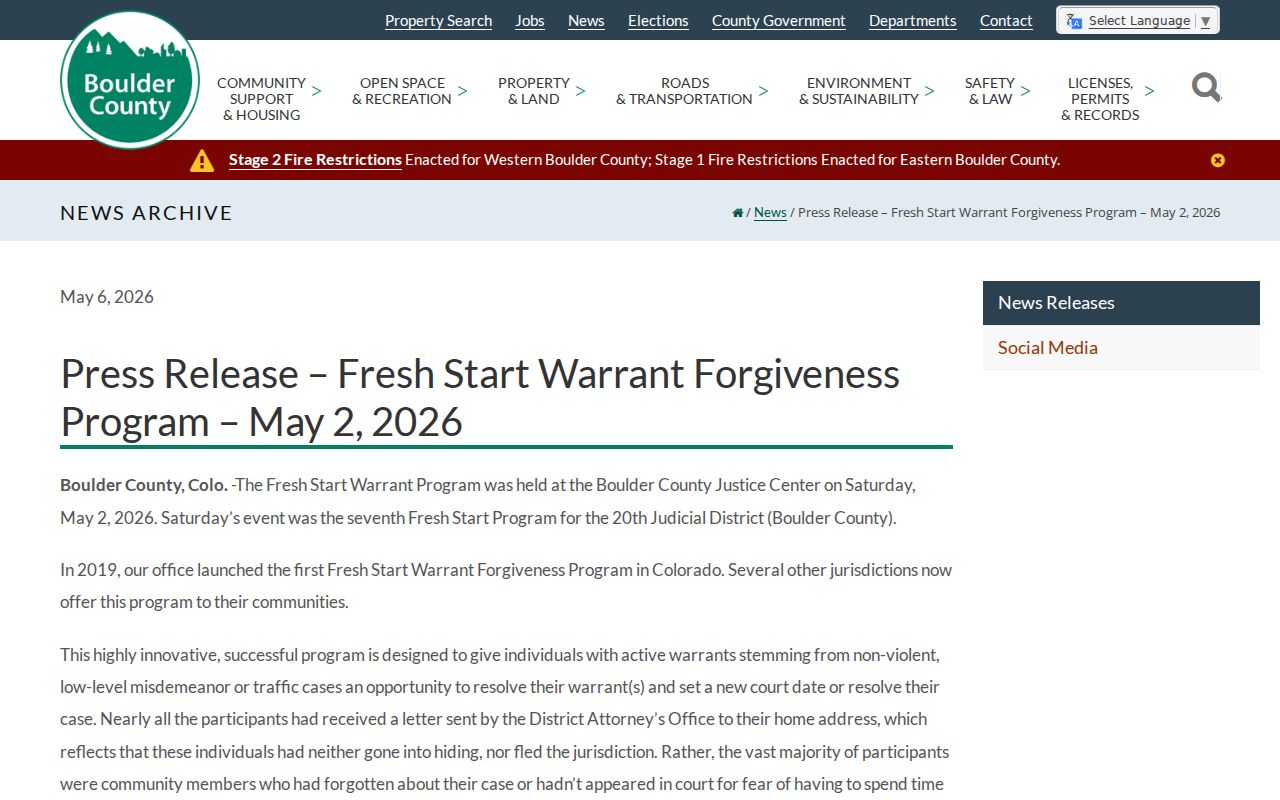
The event is not a standing promise. Confirm any future date and eligibility through a current court or district attorney announcement. Excluded cases, like affidavit warrants, stay excluded. The 2025 program drew 53 people and resolved more than 45 warrants. Those are event results only. They are not a count of all Boulder County outstanding warrants.
When Your Name Is on the Warrant List
Before you walk into a jail or police office, find out what kind of warrant you are facing. Call the issuing court in Boulder County first, and bring a lawyer into the conversation early. Ask three things. Can the case be set for a court date? Will the judge recall or quash the warrant? Is bond required, and at what amount? Get the case number and the court setting in writing so nothing depends on memory. Some district and county failure-to-appear and failure-to-comply warrants qualify for a walk-in add-on date instead of an arrest. The rules have edges, though. Municipal warrants, cases from outside the jurisdiction, Victim Rights Act matters, affidavit warrants, and certain no-bond warrants are all excluded from that shortcut. The Boulder County warrant records overview lays out the full resolution route, step by step, so you know which path fits your situation before you act.
Act with care: an active arrest or no-bond warrant can lead to custody. Confirm the plan with counsel and court staff first.
Boulder County Bond Review
An outstanding warrant in Boulder County can end in booking, and then bond takes over. The jail runs intake, and the Bond Commissioner's Unit sets the terms. It works seven days a week, applies a Colorado pretrial assessment plus a criminal-history check, and follows court standards. The unit's phone is 303-441-4626.
After booking on a Boulder County warrant, a bond hearing usually happens within 48 hours under the statute the jail cites, though legal and court conditions apply. Bond changes custody status only. It does not resolve the charge, and the next hearing still comes due. For some monetary failure-to-appear and failure-to-comply warrants, CJO 25-101 lets you pay an appearance bond in certified funds at clerk offices. Affidavit warrants stay outside that clerk route.
Boulder County Municipal Warrant Gaps
A city warrant can be active even when county sources show nothing. Boulder Municipal Court takes judge-appearance and quash calls at 303-441-3030. Longmont uses 303-774-4804, Lafayette 303-604-8000, Erie 303-926-2851, and Louisville 303-335-4652. The Boulder Municipal Court page lists a dedicated warrant line and explains the city's jurisdiction.
A payment through a city portal does not prove a Boulder County warrant is clear. For an active city warrant, Boulder offers a separate judge-appearance and quash route.
Ask when the judge's order changes and obtain current confirmation from the municipal clerk.