
Searching for a Warrant in Boulder County
Boulder County posts no complete sheriff warrant database online. The Sheriff contact directory explains that the Warrants function handles process from the Twentieth Judicial District, then points the public to Boulder County Courts at 303-441-3750. Call that number for state felony, misdemeanor, county traffic, and other district or county cases. City-code, parking, animal, photo-enforcement, and municipal traffic matters go to the city court named on the paperwork. Before you call, gather the full legal name, date of birth, case or citation number, and any notice you received. Ask the clerk to identify the issuing court, the warrant type, its current status, the bond condition, and the next authorized step.
- Identify whether the case is state, county, or municipal.
- Call Boulder County Courts for district or county confirmation.
- Use the docket tool to locate a hearing or case route.
- Contact the named municipal court for a city matter.
- Request the court or sheriff record when a document is needed.
- Take photo ID for an authorized in-person request.
Boulder County Docket Search Limits
The free Colorado Judicial Docket Search finds scheduled proceedings, not warrants. It is not a warrant database at all. A result labeled advisement, appearance on bond, review, or walk-in add-on may show the next event in a Boulder County case. A blank result proves nothing. Sealed matters, recent orders, a different date, or a municipal case can all be missing. The official interface displays docket filters rather than a roster of active Boulder County warrants.
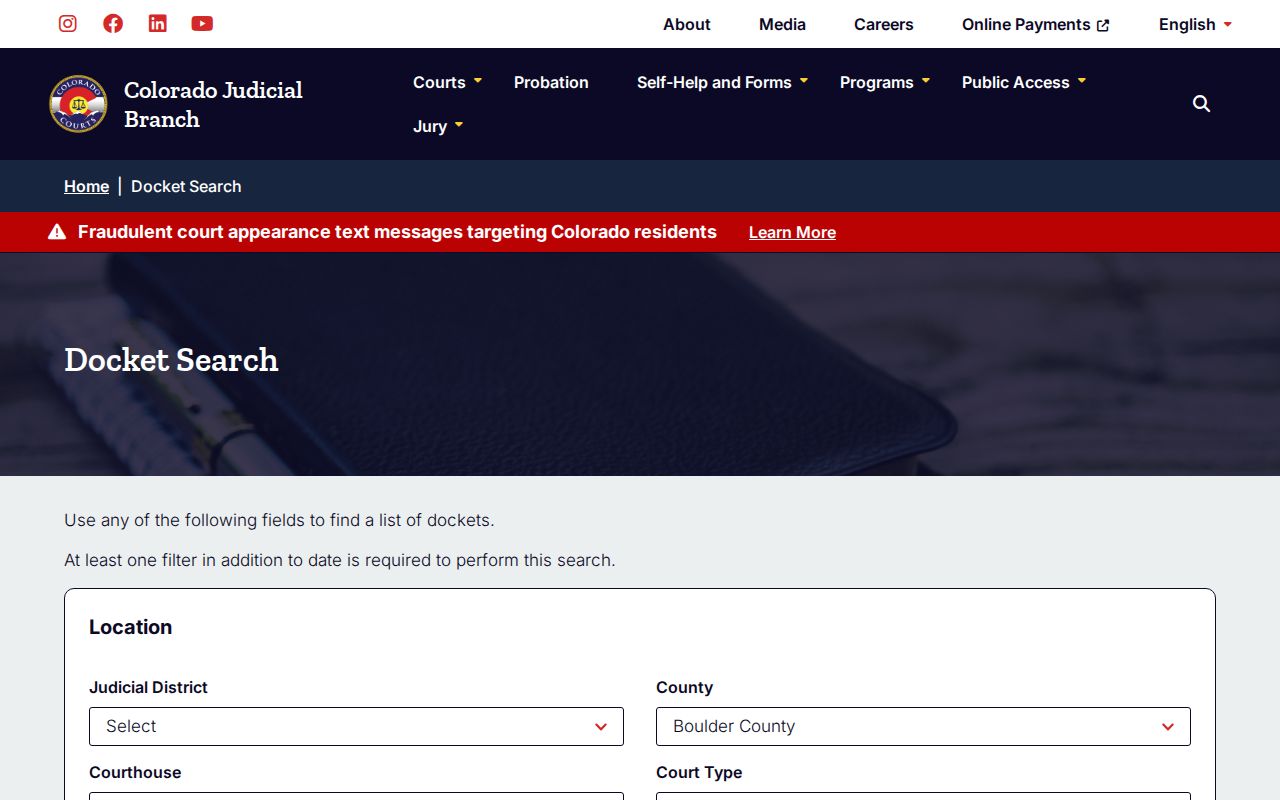
Use a docket result to find the court and case number. Then ask the Boulder County clerk whether the warrant is still active.
Warrant Search Fields Explained
The docket form requires a date plus one more filter. A case number works best. Party-name searches return similar names, and the public form has no date-of-birth field to sort them out. Export and print controls save docket rows, but they do not create Boulder County warrant records.
| Field label | Type | Required | Use |
|---|---|---|---|
| Specified date | Date | Yes | Sets the docket day. |
| District, county, courthouse | Selector | One filter | Narrows location. |
| Court type and division | Selector | No | Targets an assignment. |
| Case year, class, sequence | Text | No | Builds the case number. |
| First and last name | Text | No | Finds a party. |
| Attorney or bar number | Text | No | Finds counsel settings. |
Colorado runs no free statewide active-warrant portal for the public. Paid vendors sell court data, yet the Judicial Branch warns that vendor files are not the official record and may omit Boulder County cases.
Boulder County Name Match Checks
A common name alone proves nothing. Give the court the full legal name and date of birth, then add the case or citation number. A number may look like 2026CR###, 2026M###, or 2026T###; those show format only. Ask which court owns the record, too. Boulder, Longmont, Lafayette, Erie, and Louisville municipal courts keep local cases apart from the Twentieth Judicial District, so the county clerk cannot rule out a city warrant, and a city clerk cannot confirm a state felony warrant.
Match check: confirm the birth date, case number, issuing court, and current status with the official custodian before acting.
What a Warrant Search Shows
A docket or register of action can reveal parts of a Boulder County warrant record without showing the warrant itself. Read the issuing court and status event first. Entries like issued, served, canceled by law enforcement, or canceled after arrest each mark a point in the case timeline. Only the clerk can say whether the order is active now.
| Case or warrant number | An identifier such as 2026CR###, not proof of status. |
|---|---|
| Charge or offense | The cited law and class when public. |
| Issuing court | The division or city court controlling the case. |
| Bond | An amount, type, or no-bond condition to confirm. |
| Status event | Issued, served, recalled, quashed, or canceled. |
| Service details | Agency, arrest date, return, or cancellation entry. |
ROA stands for register of action, the court's event log. The complaint, affidavit, order, or return may take a separate request to the Boulder County clerk.
Boulder County Record Request Route
Once the clerk has pointed you to the right case, the formal route is the court record request form. That state form wants your contact details, the case information, the county, the party name, and the document type, plus whether you need certification. Expect an answer within three business days, though access limits still apply. Boulder County filers will find the checkboxes cover criminal complaints, dispositions, protection orders, tickets, and registers of action.
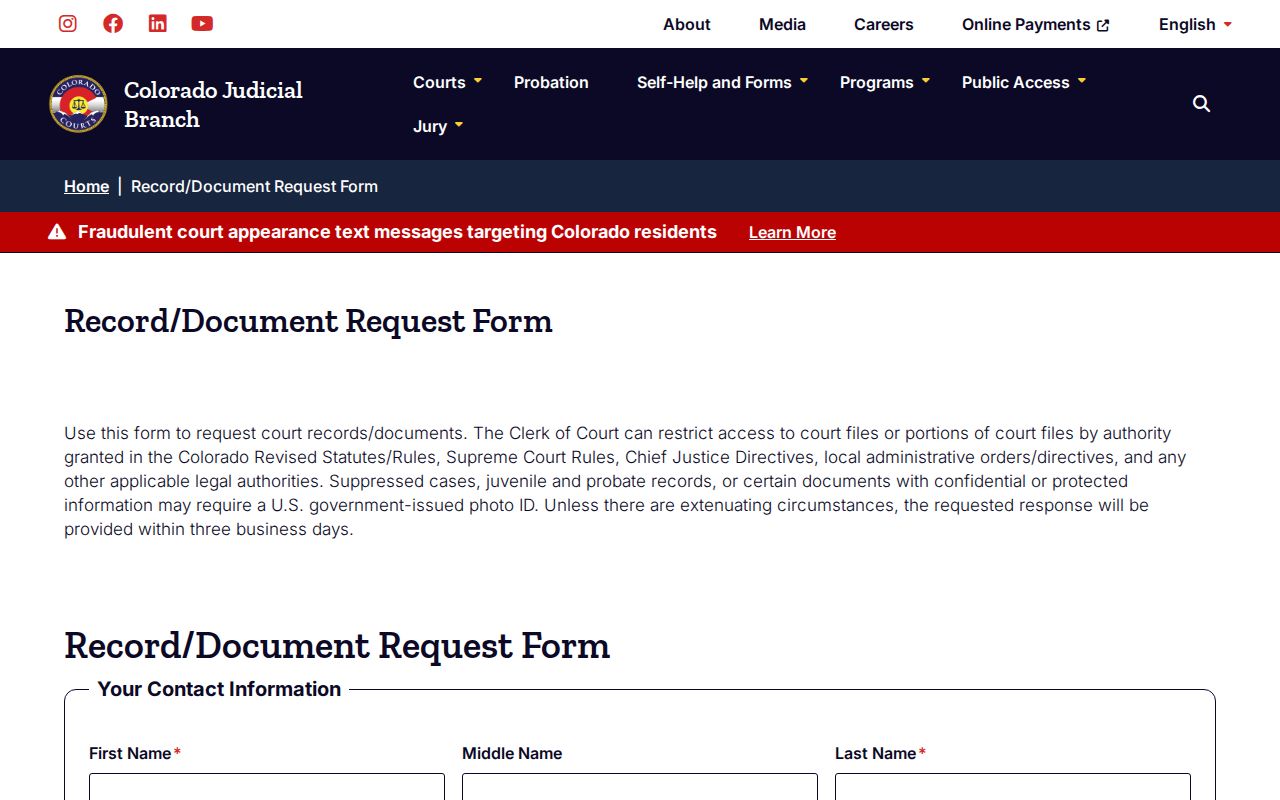
Copy pages run $0.25 each, a name search costs $5, and certification or exemplification adds $20. Research or redaction past the first hour bills at $30 per hour. When you mainly need current status, call the Boulder County clerk before paying for paper.
Where to Check Warrants in Boulder County
In Boulder County the warrant question splits by office. The Twentieth Judicial District Clerk keeps the state district and county files, while the Sheriff holds that process, serves it, and takes in-person photo-ID requests. Every municipal court runs its own local warrant. The state gives you a docket tool and document requests, not one public warrant list, and CBI criminal-history products answer a different question entirely.
District and county court
Call 303-441-3750. Court sites are 1777 6th Street in Boulder and 1035 Kimbark Street in Longmont.
Sheriff channel
Headquarters is at 5600 Flatiron Parkway. Call 303-441-3600 for routing or appear with photo ID.
Municipal cases
Contact the city court named on the summons. Local court records do not merge into one county search.
Not sure which county issued the warrant? Old paperwork or your lawyer may pin that down. Searching random county sites is no way to run a statewide Boulder County warrant check.
Boulder County In-Person Lookup
The Boulder County Sheriff says you can walk into a Sheriff office or police department with photo ID and ask. Call first, though. The clerk window shuts earlier than the courthouse itself, and anyone who might have an active warrant should ask what happens once they arrive. A qualifying failure-to-appear case may go through walk-in court. An affidavit warrant or an excluded no-bond matter can mean arrest on the spot. If bond comes up, confirm the order before you pay anything. The jail bond page lays out cash, recognizance, property, and surety bonds, along with lobby and remote ways to pay.
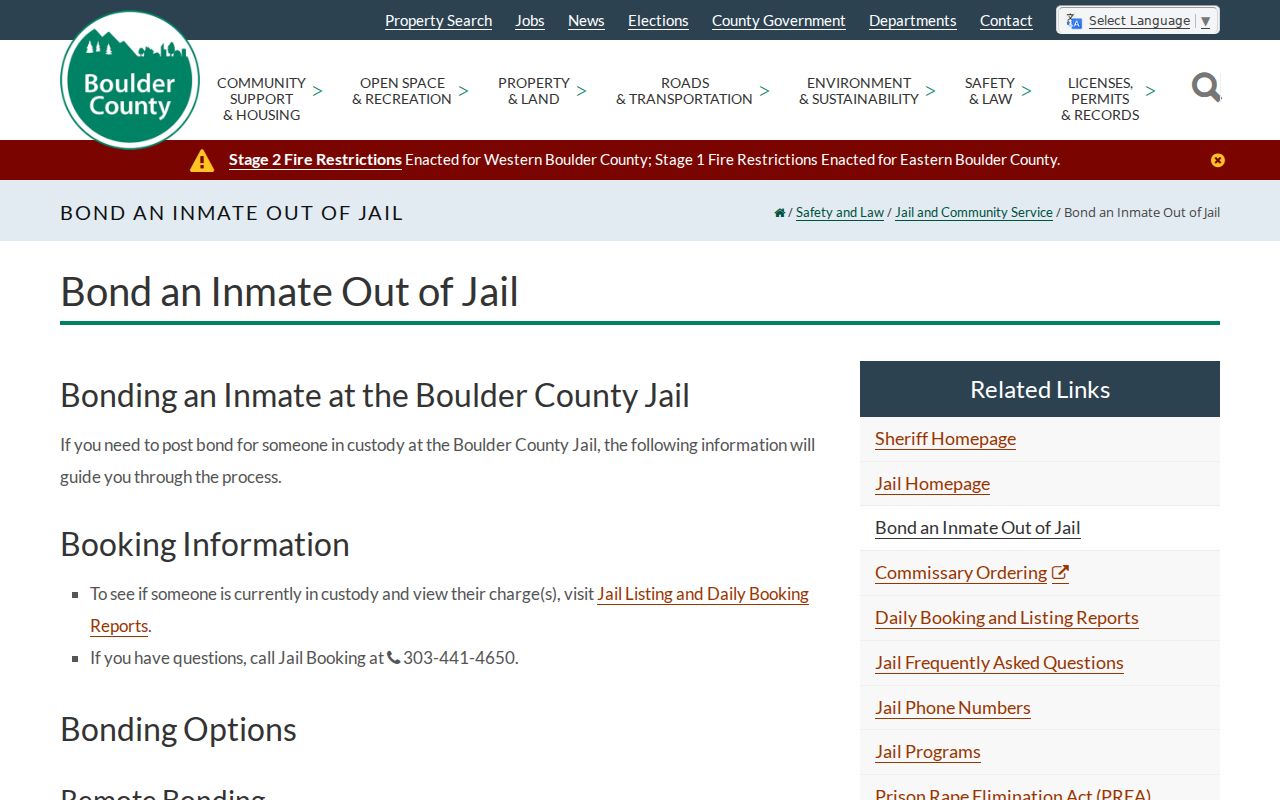
Bond changes custody or release, nothing more. The case itself goes on, so the next hearing still must be attended in Boulder County.
Boulder County Municipal Warrant Split
Boulder County's city courts each run their own warrant desk. Boulder Municipal Court has a judge-appearance and quash line at 303-441-3030, plus a warrant line at 303-441-1840. Longmont takes calls at 303-774-4804 or court@longmontcolorado.gov. Lafayette uses 303-604-8000, and Erie uses 303-926-2851. Louisville uses 303-335-4652. The Longmont and Louisville portals cover some docket, citation, and payment tasks, but a paid balance alone does not prove a judge recalled the warrant. Ask the city clerk for the warrant status and the next setting in writing. Note: the Twentieth Judicial District walk-in program excludes municipal warrants, even for cities inside Boulder County.
Restricted Warrants and Access Rules
Colorado court access runs on rules. The Judicial Branch access guide, Chief Justice Directive 05-01, and P.A.I.R.R. set what the public sees, in Boulder County and beyond. Criminal-justice records add the Colorado Criminal Justice Records Act. A law, order, case type, or safety need can still limit access.
Access limits:
Sealed and suppressed filings are not open through a routine lookup.
Juvenile records have added restrictions.
A new or unserved warrant may not appear in a public docket.
Sensitive addresses and identifiers may be redacted.
A blank web result is not proof. The issuing court or warrant office decides. In Boulder County, ask counsel before you appear, post bond, or request a date.